Overall Management
The Corporation is committed to adopting best practices in corporate governance to ensure effective management in the interests of key stakeholders and to achieve long-term sustainable growth. Led by the Chairman, the Board of Directors is the highest governing body in the Corporation and is responsible for overseeing the overall management of the Corporation’s business, focusing on the matters that affect the Corporation’s strategic direction, corporate governance, financial performance and shareholder interests. The Board comprises members with a diverse and balanced mix of skills, experience and perspectives.
Day-to-day management of the Corporation’s business is delegated to the Executive Committee which develops and implements the policies, systems and processes to deliver the Board’s strategic vision. Please refer to our Annual Report for details of our Board of Directors.
As a shareholder of various subsidiaries and associates which operate independent businesses in Hong Kong, Macao, the Chinese Mainland and overseas, the Corporation has implemented a management governance framework to provide appropriate control and oversight. Key internal controls, management practices and policies are tailored to the specific business contexts of these subsidiaries and associates. This approach enables them to maintain robust controls while ensuring the Corporation is consulted on significant matters. Regular reporting and assurance support this process, with subsidiaries and associates with material operations providing annual compliance updates to ensure transparency and effective governance.
Read more

Governance Structure
Led by the Chairman of the Corporation, the Environmental & Social Responsibility Committee (“E&SRC”) provides strategic oversight of the Corporation’s environmental and social commitments and reports directly to the Board of Directors. At the management level, the Environmental & Social Responsibility Steering Committee (“E&SRSC”), chaired by two Executive Directors, is responsible for driving and reviewing the implementation of sustainability initiatives across all MTR business units and corporate functions. The E&SRSC comprises members of the Executive Directorate and representatives from MTR's major business units and corporate functions.
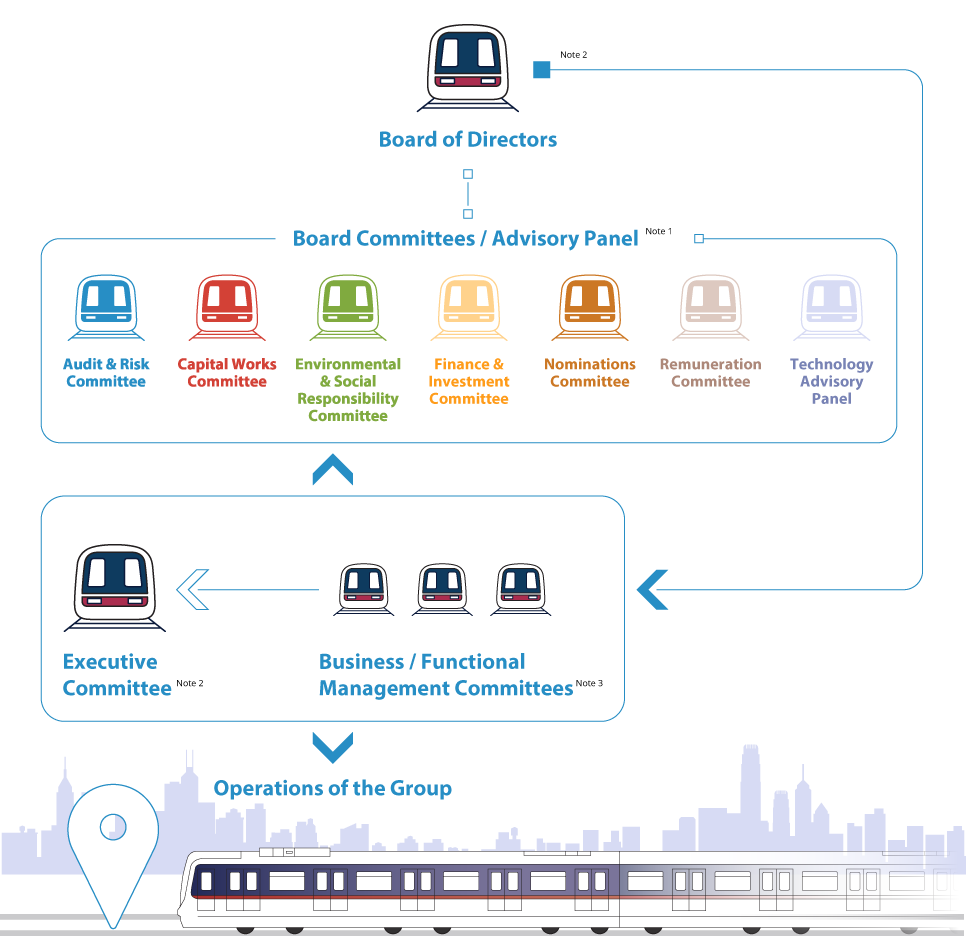
Notes:
- All Board Committees/Advisory Panel are provided with sufficient resources to discharge their duties and can seek independent professional advice (as and when required) at the Company’s expense to perform their responsibilities. The terms of reference of each Board Committee/Advisory Panel are available on the respective websites of the Company (www.mtr.com.hk) and the Stock Exchange.
- The Executive Committee is delegated by the Board to handle the day-to-day management of the Company’s business pursuant to the Articles of Association and the Protocol and is chaired by the Chief Executive Officer (“CEO”) and made up of eight other Members of the Executive Directorate.
- Business/Functional Management Committees are set up to assist the Executive Committee in the management and control of the Company’s various core businesses and functions.
Board of Directors
The Board of Directors is the highest governing body of the Corporation. Led by the Chairman, it is responsible for overseeing the overall management of the Corporation’s business, with a focus on strategic policies and corporate governance. As an integral part of good corporate governance, the Board has established six Board Committees and an Advisory Panel to provide oversight and advice on different aspects of the Corporation's affairs.
Executive Committee
The Board has delegated the day-to-day management of the Corporation's business to the Executive Committee, which is chaired by the Chief Executive Officer and comprises all members of the Executive Directorate.
Environmental & Social Responsibility Committee (E&SRC)
| Label | Content |
|---|---|
| Reports to: | Board of Directors |
| Chaired by: | Chairman of the Corporation |
| Frequency of meetings: | Twice a year |
| Composition: |
|
Environmental & Social Responsibility Steering Committee (E&SRSC)
| Label | Content |
|---|---|
| Reports to: | Executive Committee |
| Chaired by: | Legal and Governance Director and Corporate Affairs and Branding Director |
| Frequency of meetings: | Four times a year |
| Composition: |
|
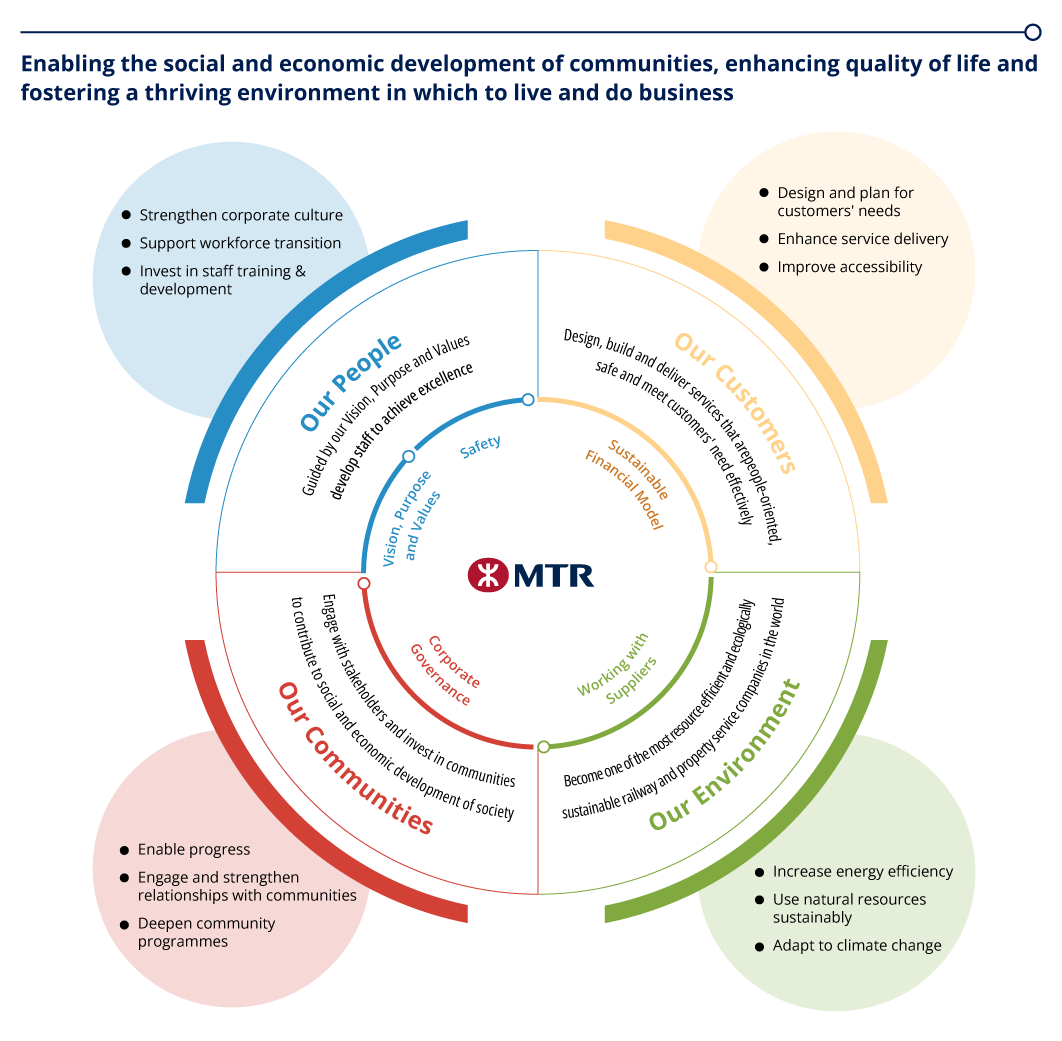
Vision, Purpose and Values
Our Vision and Values state our core philosophy, principles and ideals as we fulfil our Purpose.

Policies
-
Environmental & Social Responsibility Policy
Endorsed by the Board, our Environmental & Social Responsibility Policy guides the development and implementation of our sustainability initiatives with the goal of maintaining our position as a responsible business which creates shared value for the communities where we operate. The Policy outlines our strategy and approach to conserving resources and minimising and managing our impacts with a specific focus on our three Environmental and Social Objectives and ten commitments. This governs all our operations throughout the project lifecycle from conception and construction to long-term operation.
-
Business Ethics Policies
The Corporation is dedicated to upholding the highest ethical standards. Our Code of Conduct outlines the principles guiding the Corporation’s business ethics and obligations, detailing the policies and procedures that all levels of staff are required to follow and to uphold fairness and integrity in our operations. In line with our Vision, Purpose and Values, the Code of Conduct specifies the requirements related to ethical practices, such as prevention of corruption, bribery and illegal practices, workplace ethics and fair competition, etc. We conduct regular reviews of our Code of Conduct to keep it aligned with latest regulations and corporate priorities.
Alongside the Code of Conduct, the Corporation is committed to upholding responsible employment practices including paying a living wage that exceeds cost of living benchmarks, ensuring equal remuneration for men and women through routine gender pay gap monitoring, providing paid annual leave and preventing excessive working hours across our operations and contractors, and ensuring employees are compensated for overtime.
To support our policies on ethical conduct, the Corporation's Whistle-blowing Policy provides a confidential channel to receive complaints related to fraudulent or unethical acts, as well as potential non-compliance with laws and regulations and/or the Corporation's policies that could have a significant adverse financial, legal or reputational impact on the Corporation. The policy applies to all internal and external stakeholders, ensuring that whistle-blowers can raise concerns without fear of victimisation, discrimination or disadvantage.
More information on our approach to business ethics can be found in the Annual Report.
-
Corporate Safety Policy
Our safety-first culture is underpinned by our Corporate Safety Policy and Corporate Safety Management Framework. They clearly define our approach and objectives for safety management and ensure that safety is an essential duty and responsibility of each director, manager, supervisor and employee at MTR.
-
Environmental Policies
Our Environmental & Social Responsibility Policy outlines our strategy and approach to conserving resources and minimising and managing impacts, with a specific focus on our three Environmental and Social Objectives and ten commitments. This policy applies to all our operations throughout the project lifecycle from conception and construction to long-term operation.
Our Sustainable Procurement Policy guides employees in incorporating sustainability factors into procurement decisions. This policy supports environmental protection initiatives in the supply chain and fosters innovative environmental practices with our suppliers.
Read more
-
Human Rights Policies
The Corporation is devoted to complying with applicable labour standards throughout its business and supply chains. The MTR Corporation Modern Slavery and Human Trafficking Statement reflects our commitment to identifying and preventing any incidence of modern slavery or human trafficking within our operations and supply chain. We are committed to preventing human trafficking, forced labour, and child labour; and to upholding workers’ rights to freedom of association.
Recognising the importance of diversity in the boardroom, the Board Diversity Policy is in place to enhance the effectiveness of the Board. Accordingly, the Corporation endeavours to ensure that the Board has a balanced mix of skills, experience and diverse perspectives to support the effective execution of our business strategy. The Corporation has also adopted a new Workforce Diversity Policy ahead of the requirements of the revised Corporate Governance Code.
-
Information Security Management
The Corporation has established and maintains a comprehensive information security management framework certified to ISO 27001:2022, covering the full scope of its IT services operations, with the objective of safeguarding digital assets and protecting stakeholder information. The effectiveness of this framework is subject to regular internal and external audits, which support ongoing assessment of control adequacy and the continuous enhancement of cybersecurity risk management. A structured incident reporting and escalation mechanism is in place to facilitate the timely identification, assessment, and response to information security incidents, potential vulnerabilities, and suspicious activities, thereby strengthening the Corporation’s overall cyber resilience. To reinforce responsible use of information systems, and promote compliance with internal policies and procedures, the Corporation provides cybersecurity awareness training to all employees. From a governance perspective, the Innovation and Technology Executive Management Committee (“I&T EMC”) sets the strategic direction and policies for innovation, technology, and cybersecurity. The Information Security Management Committee, chaired by the Chief Information Officer and reporting to the I&T EMC, provides oversight of information security issues and the implementation of the Corporation’s cybersecurity strategies, policies and guidelines.
-
Privacy and Data Protection
The Corporation’s privacy policies apply across our operations and supply chain, covering Corporation's commitment to complying fully with the Personal Data (Privacy) Ordinance, and the principles to follow when dealing with personal data. A designated team of legal professionals, performing the function of the Personal Data Privacy Officer (PDPO), is responsible for handling privacy issues, with a specific PDPO email account designated to receive enquiries and issues addressed to the PDPO. Communications addressed to the PDPO are managed by this team, which serves as the point of contact for stakeholders to raise privacy issues or concerns. We conduct regular internal audits and third-party audits to safeguard compliance. We enforce strict compliance with our privacy policies, and any breach may result in disciplinary actions, including termination for serious violations.
Sustainability-related Risk Management
Sustainability is integrated into the Corporation’s Enterprise Risk Management (“ERM”) framework, with sustainability-related risks being monitored under one of the Principal Risk Areas (PRAs), “Failure to Develop, Integrate, and Implement Adequate ESG strategy”, as the Corporation streamlined enterprise level risk profile and consolidated enterprise risks under PRAs, and deployed risk dashboards which make reference to quantitative key risk indicators, risk control effectiveness assessments, and assurance information from across the Three Lines functions – enabling us to evaluate and control risks arising from our business operations. The ERM framework provides an effective management process for identifying and reviewing risks, such as privacy protection, climate risks, sustainability-related risks, across all business units, allowing us to allocate resources to manage emerging risks systematically. The Enterprise Risk Committee, the Executive Committee and the Board-level Audit & Risk Committee regularly review the Corporation’s enterprise risk profile and identify key emerging risks. Details of the Corporation’s risk identification and management process can be found in the Corporate Governance Report and the Risk Management section of the Annual Report.
In addition, the annual stakeholder-driven materiality assessment exercise helps identify, evaluate and prioritise issues which reflect the Corporation’s significant economic, environmental and social impacts. The findings of the materiality assessment are validated by the E&SRSC and reviewed by the Board-level E&SRC. For details of our materiality assessment process, please refer to the Materiality Assessment section of our Sustainability Report and Sustainability Website.